Featured OEM/ODM Photovoltaic & Low-Voltage Line
Factory-direct circuit breakers, transfer switches, and modular relays manufactured under strict ISO 9001 quality controls in Yueqing, China.




Deep Engineering Analysis: Technical Architecture of DC Circuit Breakers in Solar PV Installations
As utility-scale and commercial Photovoltaic (PV) power systems transition from traditional 1000VDC architectures to high-efficiency 1500VDC topologies, the operational demand on protective switchgear escalates exponentially. Direct Current (DC) circuit interruption presents fundamental physics challenges not encountered in Alternating Current (AC) distribution networks. Unlike AC current, which naturally crosses a zero-voltage point 100 or 120 times per second (allowing natural arc extinction), DC current maintains a continuous, uninterrupted magnitude. This structural physics reality demands specialized magnetic blowout systems, optimized arc-chute geometry, and tailored thermal-magnetic trip mechanisms within modern solar protective components.
In OEM/ODM PV circuit breaker design, achieving an Ultimate Short-Circuit Breaking Capacity ($I_{cu}$) up to 10kA or 15kA at 1000V/1500V DC requires multi-pole series configuration combined with permanent magnet directional blowout circuits. When an overcurrent or short-circuit event occurs, the Lorenz force generated by high-intensity permanent magnets embedded adjacent to the silver-alloy contact tips drives the ionization plasma arc rapidly off the contact surfaces into the arc runner plates and deep into the metal arc chute grid. Here, the electric arc is stretched, cooled, and segmented into series micro-arcs until the total arc voltage exceeds the system operating voltage, forcing immediate current extinction.
Key Structural Components of High-Reliability Solar PV Breakers
Permanent Magnet Blowout
Integrated directional or non-polarized magnetic fields that force DC electric arcs into arc-quenching chambers within 2 to 5 milliseconds of contact separation.
High-Grade AgSnO2 Contacts
Cadmium-free silver tin oxide contacts providing superior anti-welding properties, low contact resistance, and prolonged electrical endurance over 10,000 switching operations.
V-0 Flame Retardant Housing
Enclosures molded from high-density, glass-fiber reinforced polyamide (PA66), certified under UL94 V-0 to withstand intense thermal radiation during arc suppression.
Comparison Matrix: DC PV Circuit Breaker vs. Standard AC Circuit Breaker
| Performance Parameter | Solar PV DC Breaker (OEM/ODM Specs) | Standard AC Distribution Breaker | Procurement Significance |
|---|---|---|---|
| Rated Operational Voltage ($U_e$) | 250VDC (1P), 600VDC (2P), 1000V/1500VDC (4P) | 230V / 400V AC | Prevents insulation breakdown in high-voltage PV string arrays. |
| Arc Extinction Mechanism | Permanent Magnetic Blowout + Multi-slot Arc Chute | Natural Zero-Crossing Cooling Chamber | DC arcs will not self-extinguish without forced magnetic deflection. |
| Applicable Standards | IEC 60947-2, UL 489B, AS/NZS IEC 60947.2 | IEC 60898-1, EN 60898-1 | Mandatory for solar grid connection and commercial compliance. |
| Polarity Sensitivity | Non-polarized (Bi-directional current flow) | N/A (Symmetrical AC) | Crucial for battery storage where charge/discharge currents reverse. |
| Thermal Derating Threshold | Calibrated for high ambient (-40°C to +70°C) | Standard baseline at +30°C | Prevents nuisance tripping in sun-exposed outdoor combiner boxes. |
Future Trends in PV Circuit Protection Procurement & Manufacturing
The global solar protection equipment market is undergoing rapid evolution driven by energy storage system (ESS) proliferation, smart grid integration, and tightening regulatory mandates. Wholesale procurement buyers, EPC engineers, and brand importers must align their supply chain strategies with several key technological shifts anticipated over the next five years:
1. Shift Toward 1500V DC and Higher Power Densities
To reduce Balance of System (BOS) costs and minimize copper cabling losses, utility-scale and large commercial solar projects are universally adopting 1500V DC string voltages. Consequently, OEM factories are re-engineering miniature and molded case circuit breakers to handle higher dielectric stresses within compact DIN-rail form factors. Future procurement contracts will prioritize manufacturers capable of producing 4-pole 1500VDC MCBs with breaking capacities exceeding 10kA without increasing physical panel footprint.
2. Integration of Smart IoT Telemetry & Remote Reclosing
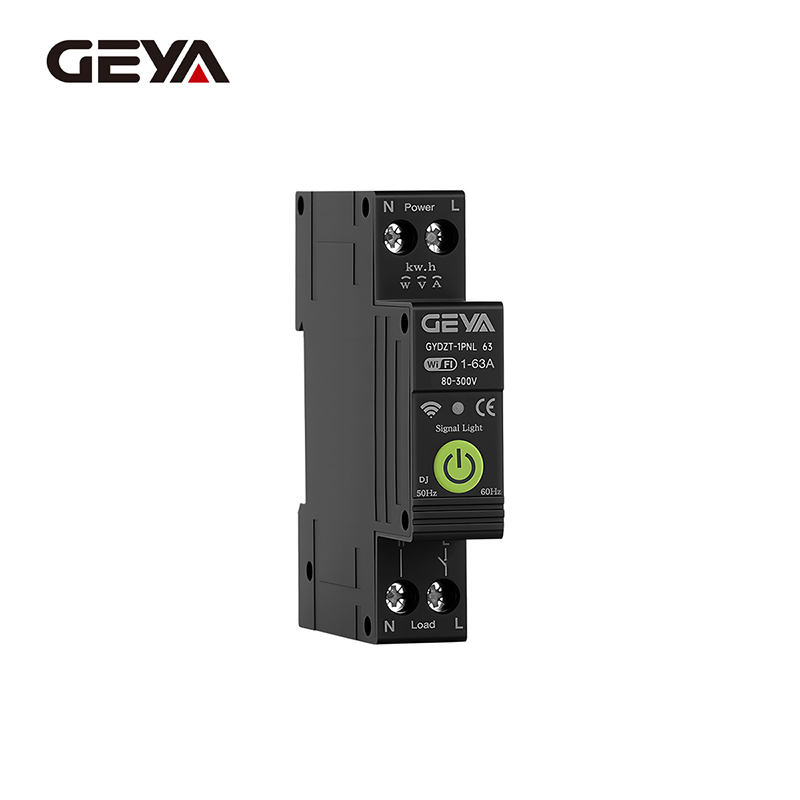
Unmanned solar farms, remote telecom base stations, and rooftop PV systems require real-time visibility into circuit health. Smart WiFi and RS485 Modbus-enabled circuit breakers—such as the GEYA GYDZT and W2R series—allow operations teams to monitor real-time voltage, current draw, power factor, and terminal temperature. Automatic reclosing functions reduce maintenance truck-rolls by remotely resetting breakers following transient voltage surges or momentary ground leakage faults.
3. Rapid Adoption of Dual-Power ATS in Hybrid Storage Networks
With residential and commercial sectors deploying hybrid solar-plus-storage solutions, Automatic Transfer Switches (ATS) have become critical node devices. The integration of zero-downtime microsecond switching (<10ms) ensures seamless transition between primary grid power, inverter battery output, and backup diesel generators. Modern OEM ATS designs must incorporate electronic interlocking, mechanical locking pins, and fire-fighting linkage terminals to meet international building safety codes.
4. Stringent Arc Fault Circuit Interruption (AFCI) Compliance
Electrical fires caused by high-voltage DC arcing remain a major operational hazard in aging solar installations. Global standards (such as UL 1699B and National Electrical Code Article 690.11) are accelerating the integration of digital signal processing (DSP) based arc fault detection within smart PV breakers. Next-generation OEM breaker lines will feature built-in high-frequency current sensors to detect characteristic arc noise signatures and disconnect string circuits before thermal ignition occurs.
Zhejiang Henergy Electrical Co., Ltd. — Factory Direct OEM/ODM Strength
Located in Daqiao Industrial Zone, Beibaixiang Town, Yueqing, Wenzhou — China's premier electrical manufacturing hub — Zhejiang Henergy Electrical Co., Ltd. brings over 16 years of specialized manufacturing experience to global B2B clients. Operating a modern factory footprint ranging between 5,000 m² and 10,000 m², our facility maintains 10+ automated and semi-automated production lines certified under ISO 9001 quality management systems.
SGS Onsite Verified
Factory operations, production equipment, employee safety protocols, and trade capabilities independently audited and certified by SGS Group.
Rigorous 3-Stage Testing
100% testing of instantaneous thermal-magnetic trip calibration, contact resistance verification, and high-potential dielectric withstand voltage tests on every unit.
Global Compliance Portfolio
Product approvals including CE, CB, SAA, UL, VDE, and CCEE, backed by full type-test documentation for seamless international customs clearance.
Whether you require private-label laser marking, custom tripping curve adjustments (Type B, C, or D), personalized retail box artwork, or custom OEM housing development, our engineering team provides end-to-end prototyping and mass-production services with flexible Minimum Order Quantities (MOQ starting at 10 to 50 pieces for standard lines).
Frequently Asked Sourcing & Technical Questions (FAQ)
Request Factory-Direct Quotations & Technical Specs
Partner with an SGS-verified manufacturer to streamline your low-voltage protection supply chain. Contact our application engineering team today for pricing, technical datasheets, and OEM customization options.
Get a Quote