Featured Industrial Electrical Circuit Protection Portfolio
As a primary Chinese OEM/ODM exporter located in Yueqing's electrical manufacturing hub, Zhejiang Henergy Electrical Co., Ltd. produces fully tested, IEC/EN 60947 and IEC/EN 60898 compliant low-voltage protection devices. Explore our core commercial catalog below.

GEYA G2R 63A 220V/110V 2P/4P ATS DIN-Rail Change Over Switch
- Rated Voltage: AC 110V / 220V (2P / 4P)
- Continuous Current Rating: Up to 63A
- Fast Transfer Speed: Grid to Generator switching
- Mounting Standard: 35mm DIN-Rail Modular

GEYA GPS6-VAWiFi 2P 63A DIN Rail WiFi Smart Reclosing Protector
- Adjustable Over/Under Voltage & Current Protection
- Integrated Residual Leakage Protection (30mA)
- IoT Remote Monitoring & Telemetry via Tuya App
- Automatic Self-Reclosing Mechanism
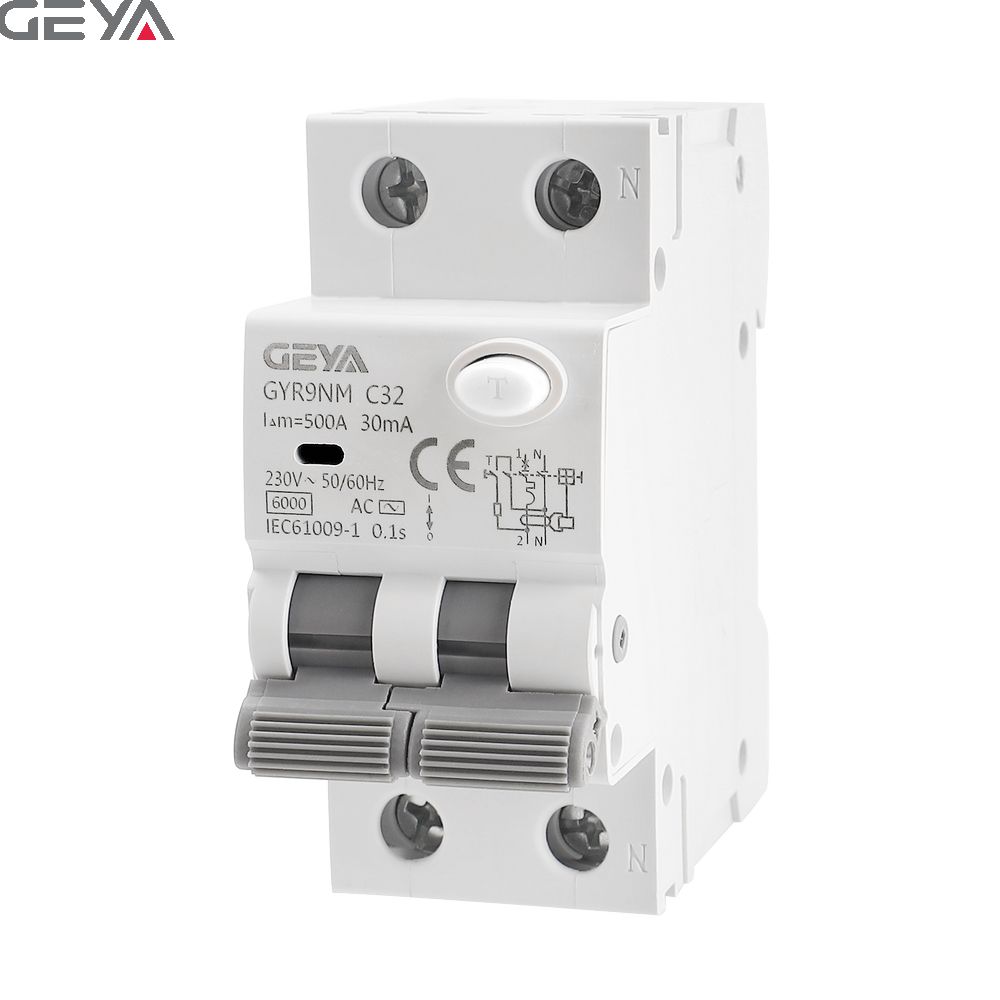
GEYA GYR9N-AC 2P 6A-25A 30mA/100mA/300mA RCBO Breaker
- Combines Overload, Short Circuit & Leakage Protection
- Rated Sensitivity: 30mA, 100mA, 300mA options
- Breaking Capacity: 6kA (IEC/EN 61009-1)
- Compact Dual-Pole 18mm Module Design
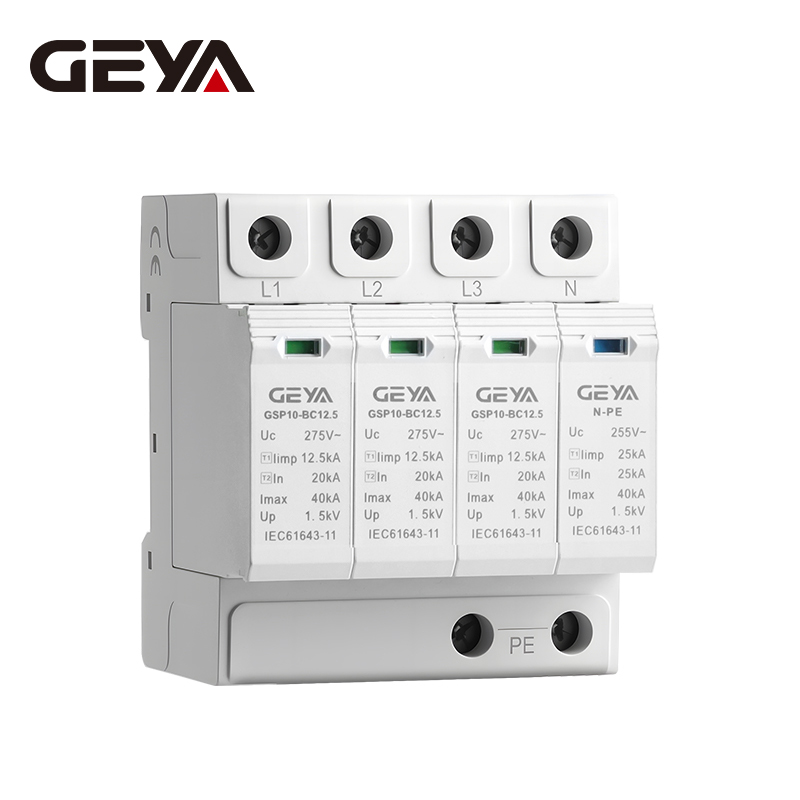
GEYA GSP10-BC12.5 40kA 275V/385V AC T1+T2 Surge Protector
- Combined Class I + Class II (T1+T2) Lightning Protection
- Impulse Current (Iimp): 12.5kA (10/350µs)
- Pluggable Cartridges with Optical Fault Indicator
- Configurations: 1P, 2P, 3P, 4P, 1+NPE, 3+NPE
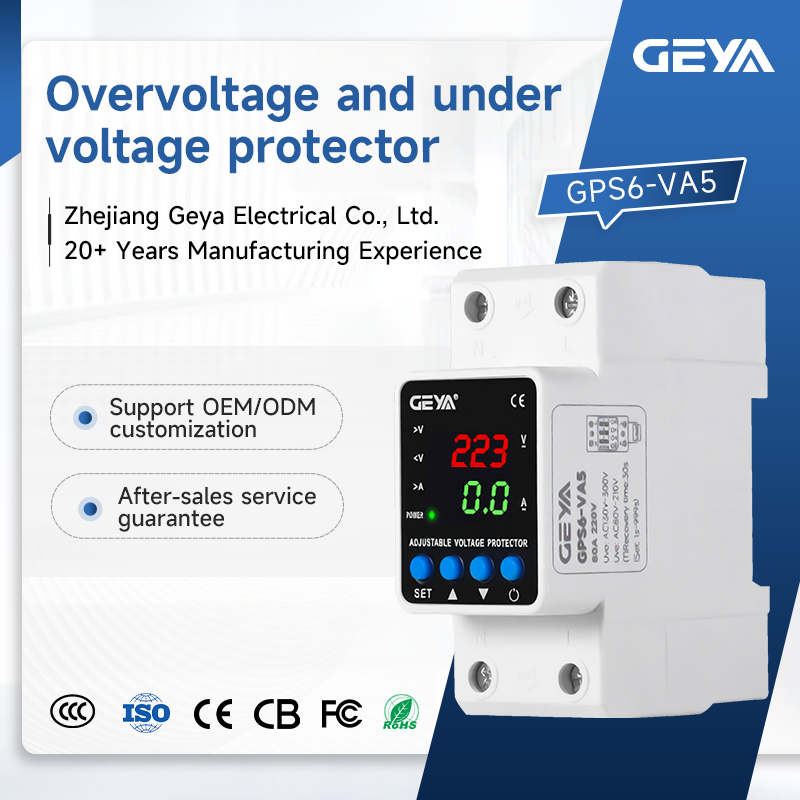
GEYA GPS6-VA5 2P 80A AC220V Auto Reconnect Voltage Protector
- High Amp Capacity: 80A Heavy-Duty Relay Rating
- Wide Frequency Response: 40Hz - 70Hz Grid Compatibility
- Digital LED Dual Display for Live Voltage & Amperage
- Customizable Reconnection Delay Timers

GEYA GYR9N Residual Current Breaker with Overload Protection
- Full Thermal-Magnetic Overload & Short Circuit Safeguard
- Current Ratings: 6A to 40A Continuous
- Leakage Sensitivity: 30mA / 100mA / 300mA
- Standard IEC 61009-1 Approval with CE/CB Marks

GEYA GRT8-M2 16A Modular Multi-Function Time Delay Relay
- Universal Power Voltage: AC230V or AC/DC 12V-240V
- 10 Multi-Function Modes (On-Delay, Off-Delay, Cycler)
- Ultra-Wide Timing Range: 0.1 sec to 10 days
- 16A Switching Output (SPDT/DPDT options)

GEYA GSP10-C40PV 2P 40kA DC Solar PV Surge Protector
- Voltage Ratings: 600VDC / 800VDC / 1000VDC
- Max Discharge Current (Imax): 40kA
- Integrated Remote Signaling Contact Terminals
- Designed Specifically for Solar PV String Boxes
Zhejiang Henergy Electrical Co., Ltd. — Your Verified OEM/ODM Partner
Established in February 2007 in the Daqiao Industrial Zone, Beibaixiang Town, Yueqing, Wenzhou (Zhejiang, China), Zhejiang Henergy Electrical Co., Ltd. stands at the epicenter of China’s low-voltage power distribution manufacturing hub. With over 16 years of specialized engineering focus, our facility encompasses between 5,000 to 10,000 square meters of precision assembly lines, automated testing laboratories, and high-capacity warehousing.
Unlike trading intermediaries, Henergy operates as a direct, SGS onsite-verified manufacturer. Our product catalog spans over 400 distinct models across 100 specific types and 5 major equipment series—including Molded Case Circuit Breakers (MCCB), Miniature Circuit Breakers (MCB), Residual Current Breakers with Overcurrent Protection (RCBO), Automatic Transfer Switches (ATS), AC Contactors, Adjustable Over/Under Voltage Protectors, and Industrial Time Relays.
We export between 81% and 90% of our total production capacity to more than 60 countries across Western Europe, South Asia, the Middle East, Southeast Asia, South America, and Oceania. Every product line conforms strictly to ISO 9001 quality management benchmarks and carries international safety accreditations such as CE, CB, SAA, UL, VDE, and CCEE.

SGS Onsite Verified Factory
Audit Report Certified: Facilities, R&D Capacity, Production Lines, and Trade Compliance independently audited by SGS Group.
Market Leadership Ratings on B2B Platforms:
- #2 Ranked Top Factory: Miniature Circuit Breakers (MCB)
- #3 Ranked Top Factory: Automatic Transfer Switches (ATS)
- #3 Ranked Top Factory: Time Delay & Protection Relays
- 4.8 / 5.0 Average Rating: Verified buyer satisfaction over 480+ completed international orders.
Industrial Development Trends in MCCB & Low-Voltage Circuit Protection
The global low-voltage equipment sector is experiencing a structural technological transition driven by smart grid digitalization, high-density renewable energy integration, and increasing commercial electrification. Molded Case Circuit Breakers (MCCB) are evolving beyond simple electromechanical fault isolation devices into intelligent power hubs.
1. Dynamic Arc Quenching & Rotary Double-Break Contacts
Modern high-capacity MCCBs demand higher ultimate short-circuit breaking capacities ($I_{cu}$) up to 100kA at 415VAC. Advanced engineering utilizes rotary double-break contact systems. When a fault current strikes, intense electromagnetic repulsion forces the contacts apart simultaneously at two points, doubling the arc voltage and drastically reducing energy let-through ($I^2t$). Combined with optimized gas-dynamic arc chutes made of arc-extinguishing polymers, fault clearing times are cut down to sub-10 milliseconds, protecting downstream cable insulation from thermal degradation.
2. Microprocessor-Based Electronic Trip Units (ETU)
Traditional thermal-magnetic trip units rely on bimetals and solenoids, which are susceptible to ambient temperature variations. Modern commercial procurement is moving toward digital Electronic Trip Units (ETU). ETUs employ Rogowski coils and microcontrollers to calculate True RMS current values. This enables granular LSI/LSIG protection settings: Long-time delay (L), Short-time delay (S), Instantaneous (I), and Ground fault protection (G). Electrical engineers can adjust pick-up thresholds and time delays via LCD interfaces or digital fieldbuses without changing physical trip hardware.
3. High-Voltage DC Circuit Breakers for Solar PV & Energy Storage
The expansion of utility-scale solar photovoltaic (PV) plants and Battery Energy Storage Systems (BESS) operating at 1000VDC to 1500VDC has created stringent requirements for DC-rated MCCBs. DC arcs lack a natural zero-crossing point, making arc suppression significantly harder than in AC networks. Chinese exporters are innovating with specialized permanent-magnet blowout fields that drive DC arcs rapidly into high-resistance grid plates. These DC-rated MCCBs provide bi-directional protection against reverse currents and thermal runaways in high-energy storage strings.
4. IoT Integration & Telemetry Communication Interfaces
Facility managers are mandating smart, connected breakers capable of integration into Building Management Systems (BMS) and SCADA networks. Modern smart MCCBs incorporate RS485 Modbus-RTU, Ethernet Modbus-TCP, ZigBee, and WiFi communication modules. They real-time stream phase voltages, line currents, power factors, total active energy (kWh), harmonic distortion, contact wear degradation percentages, and internal temperature profiles. This data empowers predictive maintenance strategies, alerting engineers to loose busbar connections or phase imbalances prior to critical outages.
5. Modularization, Compact Footprints & Environmentally Friendly Materials
Space constraints inside electrical distribution switchboards and OEM control cabinets have accelerated demand for ultra-compact frame sizes without sacrificing short-circuit ratings. Furthermore, environmental regulations such as EU RoHS (Restriction of Hazardous Substances) and REACH dictate that exporters use halogen-free, flame-retardant thermoplastics (UL 94-V0 rated) and lead-free contact alloys. Recyclable packaging, eco-friendly thermosetting resins, and minimal silver-alloy contact mass are becoming mandatory selection criteria for international engineering tenders.
Future Procurement Trends for International Breaker Importers & Wholesalers (2025–2030)
Global procurement strategies for low-voltage electrical switchgear are shifting rapidly. Importers, electrical distributors, EPC contractors, and OEM panel builders can no longer rely solely on initial unit costs. To maintain competitive advantage, procurement executives must navigate complex supply chain dynamics, regional regulatory changes, and evolving technical specifications. Below are the key strategic procurement trends shaping the MCCB and circuit breaker market:
| Procurement Vector | Legacy Sourcing Approach | Next-Generation Wholesale Trend (2025–2030) | Strategic Impact on Importers |
|---|---|---|---|
| Quality Risk Management | Basic batch sampling & self-certified supplier factory claims. | Mandatory third-party onsite verification (e.g., SGS, TÜV audits) & ISO 17025 accredited lab test reports. | Eliminates counterfeit risks, reduces field failure rates to <0.01%, and ensures seamless customs clearance. |
| Customization & Private Labeling | Off-the-shelf standardized SKUs with high minimum order quantities for OEM logo branding. | Agile OEM/ODM modular manufacturing, enabling custom current calibration, housing colors, & private label packaging at low MOQs (10-50 pcs). | Allows distributors to build proprietary brand equity without over-capitalizing on massive inventory holdings. |
| Compliance & Standards Mapping | Focus on singular local market marks (e.g., local domestic standards only). | Multi-regional standard compliance: Universal IEC/EN 60947-2, CB Scheme, CE, SAA (Australia/NZ), and UL compliance. | Enables global wholesalers to re-export a unified SKU portfolio across diverse regional jurisdictions. |
| Digitalization & Smart Features | Procuring standalone mechanical breakers without telemetric monitoring capabilities. | Mandating IoT-ready breakers with built-in energy metering, WiFi/Zigbee, and Modbus protocol compatibility. | Opens up high-margin commercial building automation and smart factory retrofitting contracts. |
| Total Cost of Ownership (TCO) | Focusing purely on unit purchase price (EXW/FOB cost). | Comprehensive TCO evaluation incorporating warranty terms, contact life expectancy, delivery term flexibility (DDP/CIF), and landed logistics. | Protects operational margins against freight volatility and reduces post-sale warranty claims. |
Key Sourcing Recommendation for Wholesalers:
When establishing supply contracts with Chinese electrical manufacturers, prioritize suppliers located within mature industrial clusters like Yueqing (Wenzhou). Vertically integrated factories that manage stamping, plastic molding, calibration, and contact welding under one roof consistently outperform fragmented assemblers in lead-time stability, lot-to-lot thermal consistency, and competitive pricing structures.
Frequently Asked Questions (FAQ) for MCCB & Circuit Breaker Procurement
Technical and commercial answers engineered by our senior application team to streamline your B2B sourcing decisions.
1. What is the technical difference between an MCCB, an MCB, and an ACB?
While all three devices serve to interrupt overload and short-circuit fault currents, they differ in current capacity, physical frame size, trip adjustability, and installation positions within electrical networks:
- MCB (Miniature Circuit Breaker): Typically rated for currents up to 125A with fixed thermal-magnetic trip curves (B, C, D curves). Breaking capacity usually ranges between 4.5kA to 10kA (IEC 60898-1). Primarily used in final sub-circuit distribution boards for residential and light commercial loads.
- MCCB (Molded Case Circuit Breaker): Covers current ratings from 16A up to 1600A with breaking capacities ($I_{cu}$) ranging from 25kA to over 100kA (IEC 60947-2). MCCBs feature molded insulating housings, often feature adjustable thermal/electronic trip settings, and support auxiliary accessories (shunt trips, undervoltage releases). Installed in main distribution boards (MDB) and industrial motor control centers.
- ACB (Air Circuit Breaker): Designed for heavy-duty main incoming switchboards, covering rated currents from 630A to 6300A with high short-time withstand current ratings ($I_{cw}$). They utilize draw-out metal frames and fully digital microprocessor trip units for complex selective coordination.
2. How should an engineering team choose between $I_{cu}$ (Ultimate Short-Circuit Breaking Capacity) and $I_{cs}$ (Service Short-Circuit Breaking Capacity)?
Both parameters are defined by the IEC 60947-2 standard:
- $I_{cu}$ (Ultimate Breaking Capacity): The maximum short-circuit current that the breaker can successfully clear twice (O - t - CO sequence) without suffering structural explosion or fire, but the breaker may no longer be operational afterwards.
- $I_{cs}$ (Service Breaking Capacity): The maximum short-circuit current that the breaker can interrupt three times (O - t - CO - t - CO sequence) and still remain fully operational, retaining its nominal dielectric strength, continuous current carrying capacity, and trip calibration.
For critical industrial infrastructure, data centers, and hospitals, buyers should select high-quality MCCBs where $I_{cs} = 100\% \, I_{cu}$ or $I_{cs} = 75\% \, I_{cu}$. A higher $I_{cs}$ ratio reflects superior arc chute durability and contact material resistance against welding under extreme fault events.
3. Why can AC-rated circuit breakers NOT be substituted for high-voltage DC circuits?
Alternating Current (AC) naturally passes through a zero-voltage point twice every cycle (50Hz or 60Hz), which assists in extinguishing the electrical arc formed when contacts open. Direct Current (DC) maintains a continuous voltage and current flow without natural zero-crossings.
If a standard AC breaker is applied to a high-voltage DC battery or solar PV string (e.g., 500VDC to 1000VDC), the arc will fail to extinguish inside a standard arc chute, sustaining an intensely hot plasma column that results in catastrophic housing meltdown, short circuits, and fire hazards. Purpose-built DC MCCBs incorporate internal permanent magnets to magnetically blow the DC arc into specialized, lengthened arc splitters.
4. What customization (OEM/ODM) options are supported for private label wholesale orders?
Zhejiang Henergy Electrical Co., Ltd. provides comprehensive OEM/ODM manufacturing customization, including:
- Private Label Printing: High-resolution pad printing or laser marking of your brand logo, customized model codes, electrical wiring diagrams, and barcode/QR trace data on front panels.
- Custom Rated Currents & Curves: Tailored thermal calibration (e.g., 40°C or 50°C ambient rating) and specialized trip characteristics.
- Housing Colors & Handles: Molded plastic enclosures customized to brand color schemes (standard grey, white, black, red operating toggles).
- Packaging & Documentation: Customized retail boxes, multi-lingual instruction manuals, master carton branding, and pallet labeling compliant with Amazon FBA or regional warehouse standards.
5. What international quality certifications are provided with Henergy product shipments?
Depending on the product family, Henergy products hold ISO 9001 quality system certifications and individual product safety approvals including CE (European Conformity), CB Scheme (IECEE test certificates accepted in 50+ countries), SAA (Standards Australia compliance), UL (North American safety standards), VDE (German electrical standard testing), and CCEE. Full certificate copies and factory test reports matching your exact order batch are attached to commercial shipping documents.
6. What are the minimum order quantities (MOQ), payment terms, and delivery options?
We maintain flexible commercial terms to support both growing distributors and high-volume importers:
- Minimum Order Quantity (MOQ): Standard ATS, voltage protectors, and relays start at just 10 to 20 pieces per model. DC MCBs start at 50 pieces. Custom OEM/ODM projects are quoted based on specific tooling and packaging requirements.
- Payment Methods: We accept T/T (Telegraphic Transfer), L/C (Letter of Credit at sight), D/P, D/A, PayPal, Western Union, and major credit cards across multiple currencies (USD, EUR, GBP, AUD, CAD, JPY, HKD, CHF, CNY).
- Trade Incoterms: FOB (Ningbo/Shanghai), CFR, CIF, EXW, FCA, CPT, CIP, DDP, and DDU.
Optimize Your Electrical Supply Chain Today
Partner directly with China's leading SGS-verified exporter of MCCBs, ATS changeover switches, voltage protectors, and circuit breakers. Request product datasheets, factory-direct wholesale pricing, and sample units for quality evaluation.