Featured Protection Components & Switchgear Solutions




1. Engineering Foundations: Electro-Thermal Dynamics of Thermal-Magnetic Circuit Breakers
In modern low-voltage electrical distribution architecture, the Thermal Magnetic Circuit Breaker (TMCB) serves as the fundamental safeguard against overcurrent hazards. Unlike purely electronic or solid-state devices, the thermal-magnetic protection engine relies on a synergistic dual-acting mechanism that couples thermo-mechanic deflection for long-term overload protection with electromagnetic displacement for instantaneous short-circuit interruption.
Technical Insight: Dual Trip Actuation Physics
Thermal Protection (Bimetallic Element): Designed to mitigate low-level, long-duration overload conditions. Operating under Joule’s First Law ($P = I^2R$), heat generated by continuous currents above the rated thresholds ($I_n$) forces a calibrated bimetallic strip—consisting of two bonded metals with contrasting coefficients of thermal expansion (e.g., brass and invar)—to bend toward the tripping latch. This inverse-time characteristic ($\tau \propto \frac{1}{I^2}$) ensures that high-margin transient current spikes, such as motor inrush currents, do not trigger false trips while sustained thermal stress disconnects the circuit before conductor insulation degradation occurs.
Magnetic Protection (Electromagnetic Solenoid): Designed for instantaneous short-circuit protection. Under catastrophic fault conditions (e.g., Phase-to-Neutral or Phase-to-Phase short circuits), fault currents rapidly escalate to multiples of rated capacity ($3I_n$ to $20I_n$). This massive magnetic flux instantly energizes a solenoid armature, driving a plunger to hit the trip bar in under 3 to 5 milliseconds. Concurrently, the arc root is forcibly swept into an arc-chute chamber consisting of insulated steel splitter plates, where the arc voltage is subdivided, cooled, and extinguished.
1.1 Trip Curve Characterization: B, C, and D Curve Dynamics
Selecting the precise trip curve classification according to IEC/EN 60898-1 and IEC/EN 60947-2 is critical for achieving optimal protection without compromising operational continuity. Wholesale buyers and system integrators must match breaker trip characteristics to downstream electrical loads:
| Trip Curve Type | Magnetic Tripping Threshold ($I_n$) | Thermal Tripping Time ($1.45 I_n$) | Primary Industrial & Commercial Applications |
|---|---|---|---|
| B Curve | $3 I_n$ to $5 I_n$ | < 1 Hour (Cold State) | Long cable runs, resistive heating loads, domestic lighting circuits, and sensitive IT equipment where short-circuit impedance is elevated. |
| C Curve | $5 I_n$ to $10 I_n$ | < 1 Hour (Cold State) | Standard commercial distribution, fluorescent lighting banks, small transformers, and general inductive loads with moderate inrush spikes. |
| D Curve | $10 I_n$ to $20 I_n$ | < 1 Hour (Cold State) | High inductive industrial machinery, heavy AC motors, industrial transformers, UPS systems, and battery storage power conversion systems (PCS). |
1.2 Breaking Capacity Physics: Ultimate ($I_{cu}$) vs. Service ($I_{cs}$) Breaking Capacity
A critical metric evaluated by engineering procurement teams is the short-circuit breaking capacity. Under standard CE and IEC protocols, breaking capacity is specified in terms of $I_{cu}$ (Ultimate Short-Circuit Breaking Capacity) and $I_{cs}$ (Service Short-Circuit Breaking Capacity):
- $I_{cu}$ (Ultimate Breaking Capacity): Represents the maximum fault current magnitude the circuit breaker can safely clear at specified test voltages without causing structural damage, explosive flashover, or welding of contacts. Following an $I_{cu}$ clearing event, the breaker is considered out-of-service for security reasons.
- $I_{cs}$ (Service Breaking Capacity): Defines the short-circuit current level at which the breaker can repeatedly clear faults (O - t - CO - t - CO operational sequence) while retaining full operational integrity, contact resistance tolerances, and thermal trip calibration. Enterprise-grade TMCBs maintain $I_{cs} = 75\%$ to $100\% \times I_{cu}$.
2. Regulatory Framework: CE Marking & International Standards Auditing
For European and international electrical component distributors, verifying authentic CE compliance is a non-negotiable step in supply chain risk mitigation. CE marking signifies compliance with key European Directives, specifically the Low Voltage Directive (LVD) 2014/35/EU and the Electromagnetic Compatibility (EMC) Directive 2014/30/EU.
Essential Verification Checklist for Sourcing CE Certified Breakers
When auditing low-voltage circuit breaker manufacturers in China, engineering buyers must verify three foundational compliance pillars:
- Harmonized Product Standards: Verification that test certificates reference IEC/EN 60898-1 for household switchgear or IEC/EN 60947-2 for industrial switchgear, issued by accredited Notified Bodies (e.g., TÜV Rheinland, DEKRA, Intertek, or SGS).
- Material Compliance (RoHS & REACH): Contacts must use cadmium-free silver alloys, specifically Silver Tin Oxide ($AgSnO_2$) instead of toxic Toxic Silver Cadmium Oxide ($AgCdO$), to comply with EU Directive 2011/65/EU (RoHS 2.0). Insulation housings must utilize flame-retardant, halogen-free thermoplastics rated UL94 V-0.
- Factory Production Control (FPC) & ISO 9001: Validating that the manufacturing plant operates under an audited ISO 9001 quality management framework with 100% automated calibration of thermal trip curves ($I_1$ and $I_2$ trip points) on the assembly line.
3. Future Procurement & Technological Trends (2025–2030)
The global low-voltage circuit breaker market is undergoing a structural transition driven by renewable energy integration, smart building automation, and stringent energy efficiency directives. Wholesalers and OEM brand buyers must align their procurement roadmaps with these key emerging trends:
3.1 Smart Grid Integration and IoT-Enabled Protection
Traditional passive circuit breakers are increasingly being augmented by Smart Digital Breakers and auto-reclosing switchgear. Integrating embedded microcontrollers, RS485 Modbus, ZigBee, and Tuya WiFi connectivity allows real-time telemetry of operating voltage, leakage current, load temperature, and power consumption directly to cloud management platforms. Automatic reclosing functions significantly minimize maintenance costs for unstaffed telecom base stations, solar farms, and remote infrastructure.
3.2 High-Voltage DC Circuit Breakers for Solar PV & Battery Storage
With the global surge in commercial solar PV installations and Battery Energy Storage Systems (BESS), demand for specialized DC Miniature Circuit Breakers (DC MCB) rated at 250VDC, 500VDC, 1000VDC, and up to 1500VDC has grown rapidly. Unlike AC currents, which naturally pass through a zero-crossing point twice per cycle (easing arc extinction), DC currents exhibit constant voltage profiles. DC circuit breakers require permanent magnetic blowout elements embedded in the arc chamber to physically force high-voltage DC arcs into the splitter plates.
3.3 Modularization & Hybrid Multi-Function Switchgear
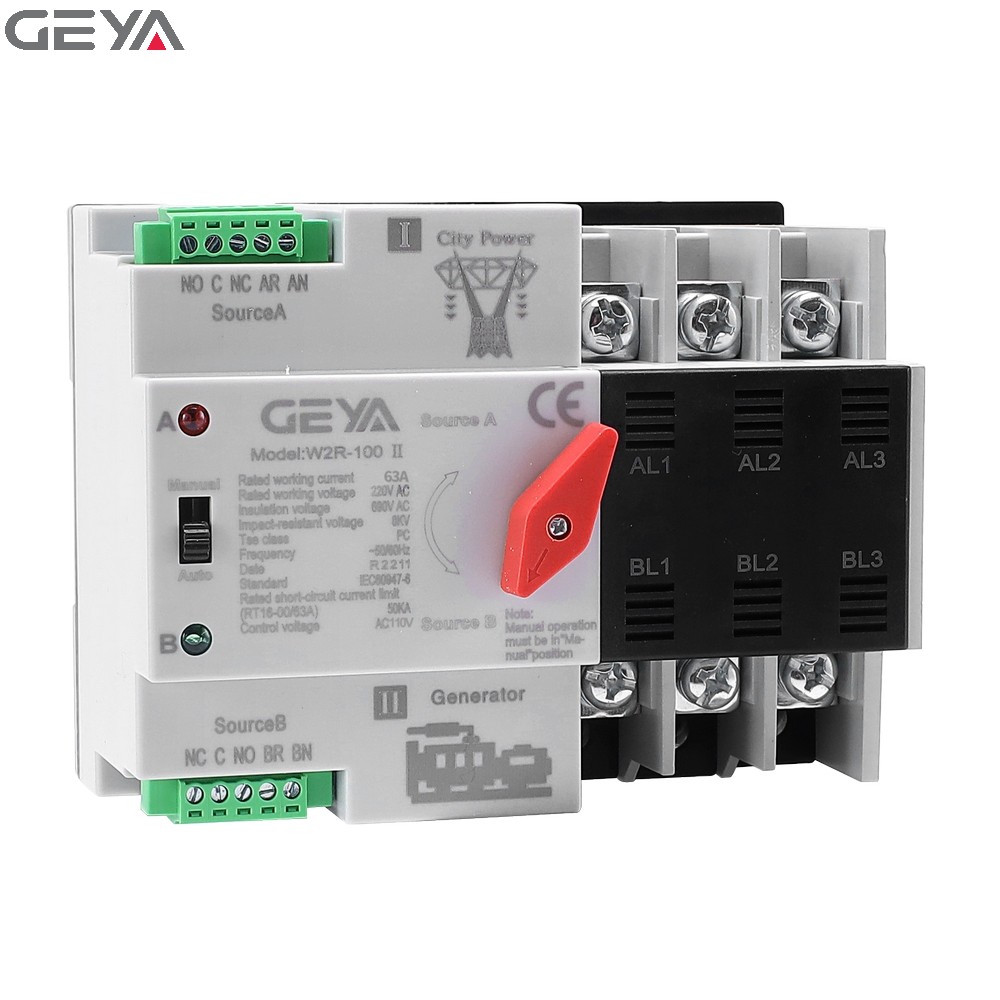
Panel builders are demanding higher functional density on standard 35mm DIN rails. Procurement is shifting rapidly toward hybrid switchgear, such as combined RCBOs (Residual Current Breaker with Overcurrent Protection) in single-module (18mm) widths, integrated over/under-voltage protection relays with digital LED displays, and dual-power Automatic Transfer Switches (ATS) equipped with fire protection isolation triggers.
4. Enterprise Strengths & Manufacturing Excellence: Zhejiang Henergy Electrical / GEYA
As an industry leader in low-voltage electrical component manufacturing, Zhejiang Henergy Electrical Co., Ltd. (operating under the internationally recognized brand GEYA) represents the benchmark for Chinese manufacturing precision, regulatory compliance, and scalable OEM production capacity.
| Operational Capability | Factory Performance Metrics & Audited Specifications |
|---|---|
| Establishment & Location | Founded in February 2007; Located in Daqiao Industrial Zone, Beibaixiang Town, Yueqing, Wenzhou, Zhejiang, China (Global Electrical Hub). |
| Third-Party Accreditation | SGS Group Onsite-Verified Factory; ISO 9001 Quality Management System Certified; Average Buyer Rating 4.8 / 5.0. |
| Production Capacity & Lines | 10+ dedicated automated production lines; 5,000 to 10,000 square meter state-of-the-art facility; 400+ distinct product models. |
| Export Reach & Volume | 81% - 90% total export volume; Active distribution network across 60+ countries (Europe, South Asia, Middle East, Americas, Australia). |
| Global Certification Scope | CE, CB (IECEE), SAA (Australia/NZ), UL (North America), VDE (Germany), CCEE (China Safety). |
| OEM / ODM Services | Full custom branding, private label packaging, custom current/voltage calibrations, modified trip curves, and rapid tooling development. |
Our production floor combines automated stamping, laser welding of silver contacts, automated coil winding, and digital calibration systems that test 100% of finished units against thermal delay and instantaneous magnetic trip limits. By strictly controlling the supply chain from raw copper and thermoplastic raw materials to final packaging, we eliminate defect vectors inherent in outsourced assembly operations.
5. Global Procurement & Technical FAQ
To streamline sourcing inquiries for electrical wholesalers, panel builders, and engineering contractors, our technical engineering team has addressed the top technical and procurement questions:
For standard factory-branded products (GEYA series), our MOQ starts at 10 to 20 pieces per model. For private-label OEM packaging, custom logo laser engraving, and modified housing colors, MOQ generally ranges from 50 to 100 pieces for DC MCBs and smart switchgear, making our custom production services accessible to growing distributors.
An MCB (Miniature Circuit Breaker) protects against electrical overloads and short circuits. An RCCB (Residual Current Circuit Breaker) detects residual earth leakage current (e.g., 30mA for human shock protection) but does not provide overcurrent or short-circuit protection. An RCBO combines both functionalities into a single compact DIN-rail device, offering complete overcurrent, short-circuit, and earth leakage protection simultaneously.
No. AC circuit breakers should never be installed in DC systems. AC arcs extinguish naturally when the alternating current crosses 0 volts (50/60Hz). DC currents maintain constant voltage, creating high-energy arcs during contact separation that will melt AC arc chutes and cause catastrophic fire damage. Solar PV strings require dedicated DC MCBs equipped with specialized arc-extinguishing permanent magnets and arc splitters rated for up to 1000VDC or 1500VDC.
Every shipment can be accompanied by complete test report copies matching your specific order batch, including CE Declaration of Conformity (DoC), CB Test Certificates under IEC 60898-1 / IEC 60947-2, SAA certificates for Australian/New Zealand customs, and ISO 9001 FPC audit documentation.
We support standard international trade Incoterms including FOB, CFR, CIF, EXW, FCA, CPT, CIP, and DDP (Delivered Duty Paid). Accepted payment channels include Wire Transfer (T/T), Letter of Credit (L/C at sight), D/P, PayPal, Western Union, and Credit Card processing in multi-currency formats (USD, EUR, GBP, AUD, CAD, JPY, HKD, CNY).
6. Sourcing Best Practices & Vendor Selection Guide
When selecting a low-voltage circuit breaker manufacturer, procurement directors must weigh long-term operational reliability over short-term component cost reductions. Inexpensive switchgear using copper-clad aluminum coils, recycled housing plastics, or silver-cadmium contacts presents severe safety, fire, and regulatory non-compliance risks.
Key Component Quality Indicators to Inspect
- Arc Chute Assembly: Insist on 9 to 13 plates per arc chute to ensure rapid arc voltage build-up and arc quenching under 5ms.
- Contact Tip Material: Ensure 99.9% pure $AgSnO_2$ contact pads with minimum 0.3mm silver alloy thickness to prevent contact welding during heavy short-circuit interruptions.
- Terminal Clamp Integrity: Terminals should be constructed of zinc-plated electro-copper or high-strength brass capable of sustaining maximum tightening torque without thread stripping.
- Housing Polymer: Verify the use of virgin Polyamide 66 (PA66) reinforced with glass fiber, possessing high glow-wire ignition temperature (GWIT > 750°C) and UL94 V-0 flame-retardant properties.
Partner with a Certified Low-Voltage Electrical Factory
Ready to source CE, CB, and SAA certified circuit breakers, automatic transfer switches, and digital protection relays directly from an SGS-verified manufacturer? Request a custom wholesale quotation or technical datasheet today.
Send an Inquiry