CE Certified DC & AC Protection Solutions
High-reliability low-voltage switchgear engineered for solar PV combiners, commercial energy storage systems (BESS), and industrial automation arrays.
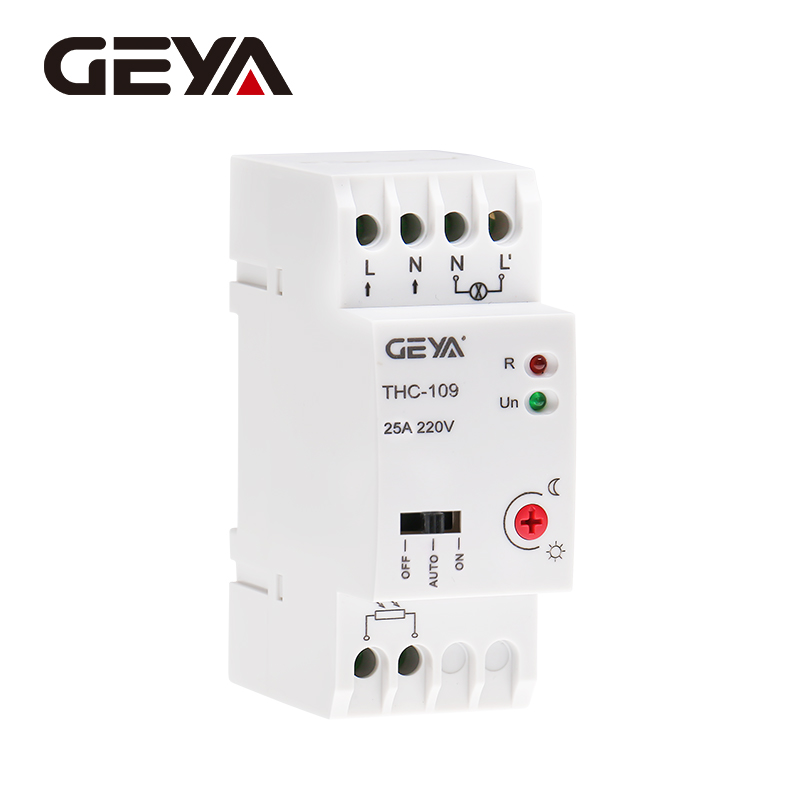
GEYA THC-109B 16A/20A/25A Light Control Timer Switch
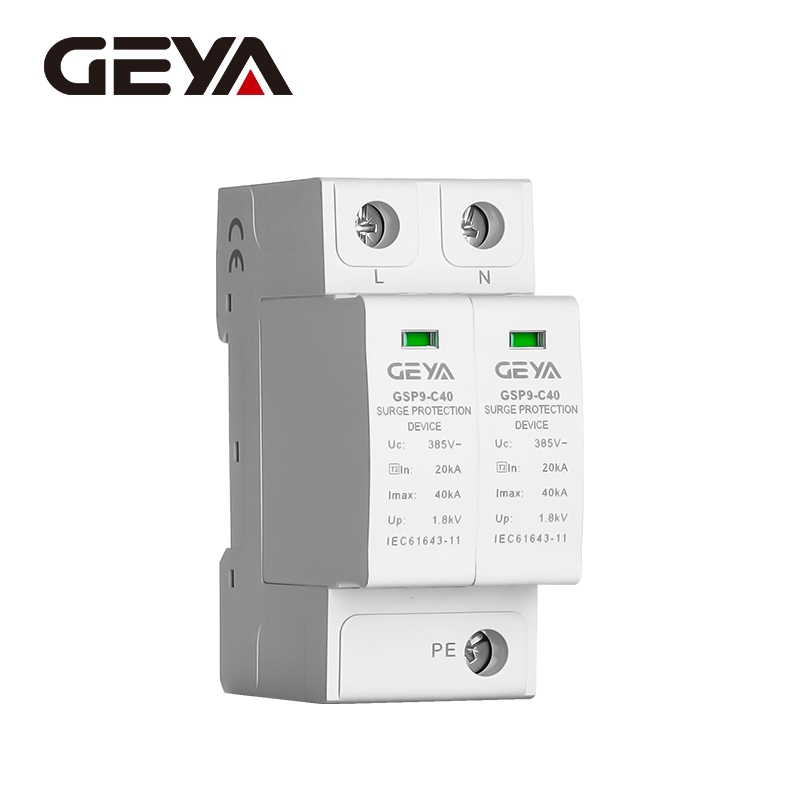
GEYA GSP9-C40 40kA T2 Pluggable Surge Protector

GEYA GYR9N RCBO Overload Protection Breaker

GEYA G2R 63A 2P/4P DIN-Rail Automatic Transfer Switch

GEYA GRT8-M2 16A Modular Multi-Function Time Relay
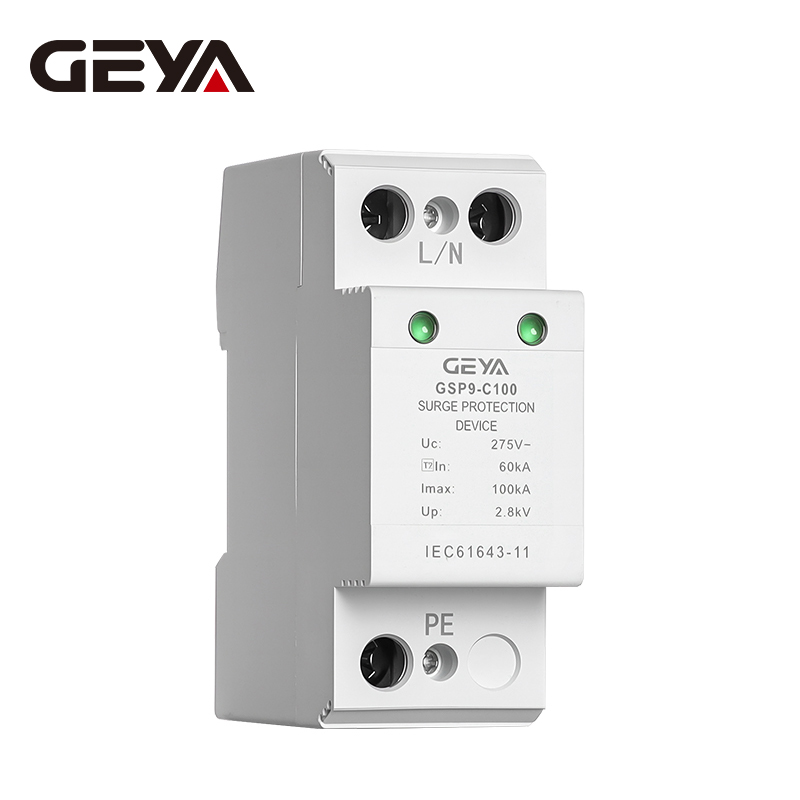
GEYA GSP9-C100 100kA High-Capacity AC SPD
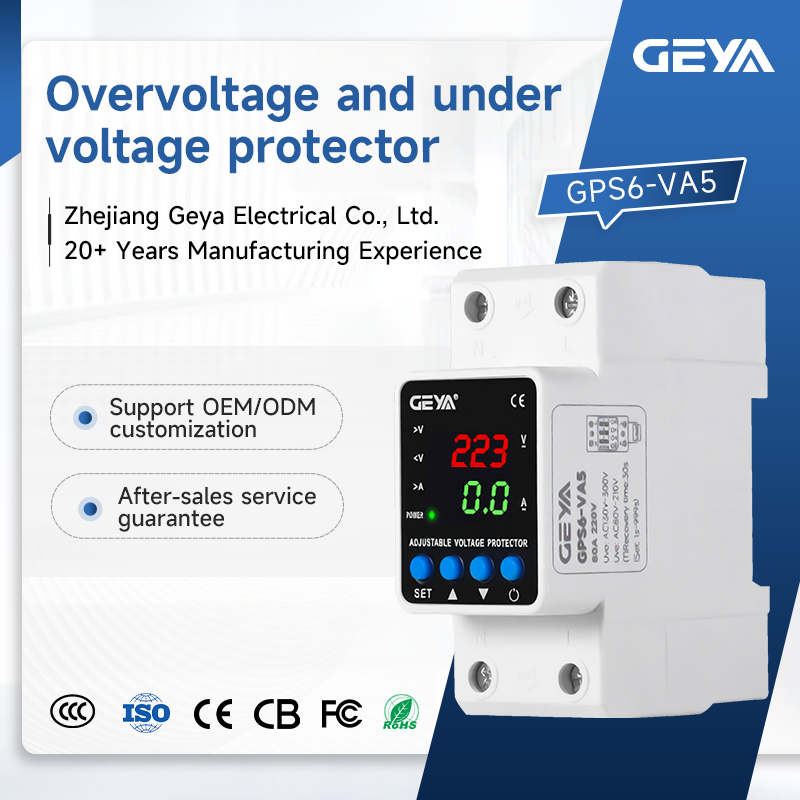
GEYA GPS6-VA5 2P 80A Auto Reconnect Protector

GEYA GSP10-C40PV 1000VDC 40kA Solar PV DC SPD
The Engineering Challenges of Direct Current Arc Quenching
Why standard AC Miniature Circuit Breakers (MCBs) fail catastrophic thermal tests when applied to high-voltage Photovoltaic (PV) strings and Battery Energy Storage Systems (BESS).
Zero Natural Current Zero-Crossing
Unlike Alternating Current (AC) which naturally passes through zero current twice per cycle (allowing arcing ion channels to cool and collapse), Direct Current (DC) maintains uninterrupted continuous magnitude. Extinguishing a 1000V DC electric arc requires forceful stretching of the ionized plasma into high-capacity ceramic arc splitter plates.
Permanent Magnet Arc Blowout
CE certified DC Miniature Circuit Breakers integrate polarity-sensitive permanent magnets embedded adjacent to the primary silver-alloy contacts. The magnetic field exerts a Lorentz force ($F = q(\mathbf{E} + \mathbf{v} \times \mathbf{B})$) that propels the electric arc away from contacts directly into the arc chute assembly within milliseconds.
Dielectric Distance & Contact Gaps
DC breakers feature extended physical contact opening distances and multi-stage arc chutes (typically 12 to 14 plates per pole). This architecture ensures isolation rated voltage (Ui) up to 1200V DC, preventing flashover reignition under heavy short-circuit fault currents up to 10kA.
Engineering Parameters: Standard AC MCB vs. Purpose-Built Solar DC MCB
| Performance Specification | Standard AC Circuit Breaker | Certified DC Solar Circuit Breaker (GYM9 Series) |
|---|---|---|
| Operating Voltage Range (Ue) | 230V / 400V AC | 250V DC (1P), 500V DC (2P), 750V DC (3P), 1000V-1200V DC (4P) |
| Arc Extinguishing Mechanism | Standard De-ion grid with passive cooling | Lorentz Force Permanent Magnet Blowout + Extended Arc Chute |
| Polarity Requirement | Non-Polar (Symmetrical) | Polarized (+ / - marked) or Non-Polarized (BESS Option) |
| Ultimate Breaking Capacity (Icu) | 4.5kA / 6kA (at 400V AC) | 6kA / 10kA (IEC 60947-2 tested at 1000V DC) |
| Tripping Characteristic Curves | B, C, D Thermal-Magnetic Curves | C Curve (Commercial Solar) & K/Z Curves (Semiconductor/PV String) |
| Enclosure Flame Retardancy | UL94-V1 Standard Plastic | UL94-V0 Self-Extinguishing Thermo-Hardened Polycarbonate |
Future Trends Driving Global DC Circuit Breaker Sourcing
An executive analysis of regulatory shifts, renewable grid upgrades, and smart microgrid demands altering OEM contract specifications worldwide.
Transition to 1500V DC Systems
Utility-scale solar farms are shifting from 1000V to 1500V DC topologies to minimize copper cable losses and string count. B2B importers are re-tooling procurement toward 4-pole series-connected circuit breakers engineered for high isolation ratings.
Integration of Smart IoT & Telemetry
Wholesale switchgear buyers increasingly demand intelligent reclosers equipped with RS485 Modbus, Tuya WiFi, or Zigbee modules for real-time remote tripping, current leakage diagnostics, and predictive thermal monitoring.
Bidirectional BESS Protection
Battery Energy Storage Systems require DC breakers capable of interrupting fault current in both charging and discharging directions. Non-polarized magnetic blowout technology is rapidly overtaking legacy polarized DC breakers.
Combined Protection Units (SPD + MCB + Rapid Shutdown)
System integrators are prioritizing unified modular DIN-rail enclosures containing pre-wired DC MCBs, Type 2 Surge Protection Devices (SPDs), and motorized remote switches to reduce installation labor costs.
Market Acceleration: Regulatory Push & CE Marking Requirements
The European Union’s fit-for-55 climate targets and stringent implementation of the Low Voltage Directive (LVD 2014/35/EU) have mandated strict safety thresholds for import switchgear. Custom authorities across Europe, Australia (SAA), and South America now require rigorous third-party verification of short-circuit performance testing under EN 60947-2 standards.
Furthermore, distributors who secure long-term OEM contracts are ensuring their Chinese factory partners possess ISO 9001 certified Quality Management Systems and onsite third-party factory assessments (such as SGS Group audit reports) to guarantee zero shipment discrepancies.
Zhejiang Henergy Electrical Co., Ltd. — Enterprise Strength
Direct factory production in Yueqing, Wenzhou — China's electrical hardware capital. SGS onsite-verified low-voltage manufacturing partner since 2007.
Vertical Manufacturing Infrastructure
Operating over 10 automated assembly and testing lines covering an expansive 5,000 to 10,000 m² modern workshop. We control stamping, plastic moulding, calibration, and contact welding under one roof to eliminate supply chain variance.
Multi-Stage Quality Inspection Protocol
Equipped with 9 high-precision testing instruments operated by senior engineers with 5+ years of specialist expertise. Every single batch undergoes 100% instantaneous thermal magnetic tripping calibration, insulation resistance checks, and mechanical lifespan endurance testing.
Global OEM / ODM Contract Experience
With over 12 years of private-label OEM manufacturing experience, our product catalog spans over 400 models across 5 core product series. We support custom laser-marked branding, custom enclosure colorways, tailored voltage/ampere curves, and multi-lingual retail packaging.
Verified Compliance & Global Export
Exporting 81%–90% of overall production across 60+ countries throughout Europe, South America, the Middle East, and Southeast Asia. Certified compliant with CE, CB Scheme, SAA, and ISO 9001 quality management benchmarks.
Frequently Asked Questions for Wholesale Sourcing
Detailed answers provided by our engineering and international export logistics team to assist panel builders, distributors, and EPC contractors.
How do I properly select between a Polarized and Non-Polarized DC Circuit Breaker?
Polarized DC Breakers have specified positive (+) and negative (-) terminal markings. They utilize asymmetrical permanent magnetic fields to direct the arc into the extinguishing chamber. They are cost-effective and highly efficient for uni-directional power flow like solar PV strings feeding an inverter. However, connecting a polarized breaker in reverse will draw the arc into the mechanical operating spring, causing instant destruction upon fault tripping.
Non-Polarized (Bi-Directional) DC Breakers feature symmetrical internal magnetic blowout arrangements. They safely extinguish fault currents flowing in either direction. They are mandatory for battery energy storage systems (BESS), electric vehicle charging stations, and bidirectional microgrids where energy flows alternate between charge and discharge modes.
What are the critical compliance documents required for customs clearance in the EU?
To import DC Circuit Breakers into the European Union, buyers must verify:
- CE Declaration of Conformity (DoC): Issued under the Low Voltage Directive (LVD) 2014/35/EU and Electromagnetic Compatibility (EMC) Directive 2014/30/EU.
- IEC/EN 60947-2 Test Reports: Issued by accredited laboratories verifying short-circuit breaking capacity (Icu), service breaking capacity (Ics), and impulse withstand voltage (Uimp).
- RoHS & REACH Certifications: Guaranteeing restriction of hazardous substances within plastics and contact alloys.
Zhejiang Henergy Electrical provides full certified documentation packages with every formal wholesale quote.
How does ambient temperature affect the thermal-magnetic trip curves of DC MCBs in outdoor solar boxes?
Circuit breaker thermal bimetallic strips are calibrated at a reference ambient temperature of 30°C to 40°C. Outdoor solar combiner boxes installed in tropical or desert environments frequently experience internal temperatures exceeding 55°C. At these temperatures, the breaker will undergo thermal derating—tripping at a lower current than its nominal rating ($I_n$).
Engineers must apply a derating correction factor (typically 0.82 to 0.90 at 55°C) or specify breakers manufactured with high-temperature glass-filled nylon housings and calibrated bimetals designed specifically for extreme ambient environments.
What is the Minimum Order Quantity (MOQ) and lead time for OEM private labeling?
For standard catalog items (ATS, SPDs, Time Relays), MOQ starts as low as 10 to 20 pieces. For custom DC Circuit Breaker orders requiring laser-printed buyer logos, custom rated current adjustments, or customized retail color boxes, the baseline MOQ is 50 to 100 units depending on the pole configuration.
Standard production lead time ranges between 10 to 20 business days following sample approval and deposit confirmation. Accelerated air freight or containerized sea shipment (FOB, CIF, DDP) options are fully supported.
What is the difference between Breaking Capacity ratings Icu and Ics?
Icu (Ultimate Short-Circuit Breaking Capacity): The maximum fault current the circuit breaker can break without sustaining permanent damage that prevents its operation. Tested following an O - t - CO sequence (Open - time - Close Open).
Ics (Service Short-Circuit Breaking Capacity): The fault current level at which the breaker can successfully interrupt multiple consecutive times and remain fully operational without operational degradation. High-quality industrial DC MCBs maintain $Ics = 75\% \text{ to } 100\% \text{ of } Icu$.
Which payment terms and incoterms does Zhejiang Henergy Electrical support?
We accommodate flexible commercial arrangements tailored to international procurement standards:
- Incoterms: FOB (Ningbo/Shanghai), CFR, CIF, EXW, FCA, CPT, CIP, and DDP (Delivered Duty Paid door-to-door).
- Payment Channels: T/T (Telegraphic Transfer), L/C at sight, D/P, PayPal, Western Union, or Credit Card.
- Supported Currencies: USD, EUR, GBP, AUD, CAD, JPY, HKD, CHF, and CNY.
Request Direct Factory Quotations & Technical Specifications
Partner with an SGS onsite-verified electrical equipment manufacturer. Submit your detailed bill of materials or requested product specifications today to receive competitive wholesale pricing within 24 hours.