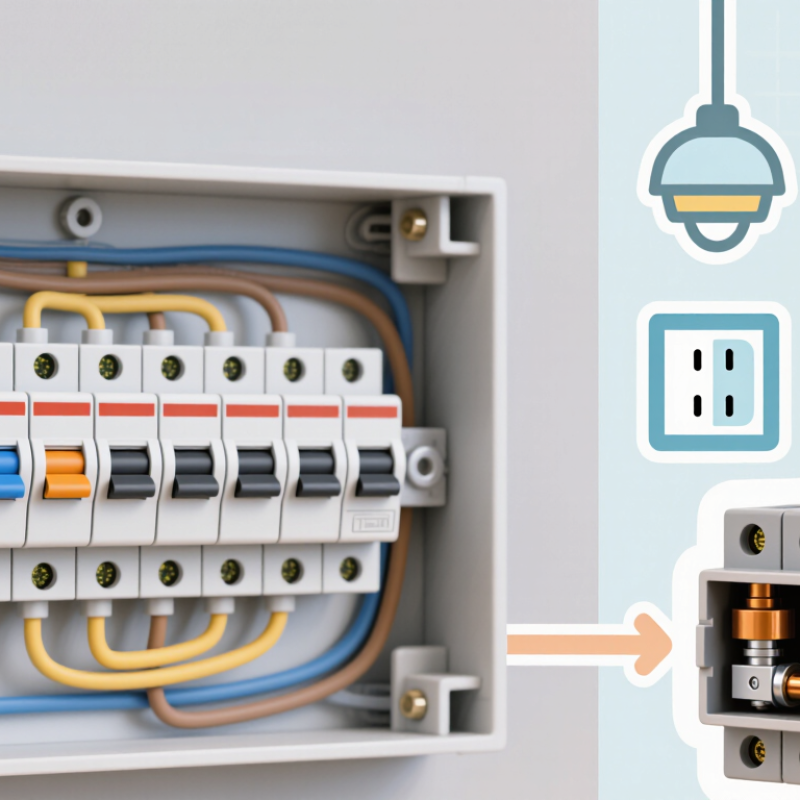
A Miniature Circuit Breaker (MCB) is a compact device designed to interrupt current when an overload or short circuit occurs. In a home distribution board, it can protect a lighting circuit or socket branch without replacing a fuse after every trip. Its small toggle and clear circuit label make isolation easier to understand during routine maintenance. Small component. Important responsibility.
Selection still requires care. The breaker’s rated current, trip characteristics, breaking capacity, and compatibility with the installation all matter. A rating chosen without checking the wiring may offer poor protection. An MCB also does not replace residual-current protection where that protection is required. For a real installation, consult a qualified electrical professional and follow applicable product instructions and local requirements.
The expert quotation below is illustrative, not a verified statement from a real industry professional. Electrical protection specialist Alex Morgan, a fictional expert voice for this introduction, puts the point this way: “Choose the breaker for the circuit it protects, not merely for the space it saves.” That principle captures the appeal of a Miniature Circuit Breaker: compact construction, convenient reset, and focused circuit protection. It is not a cure-all. The right choice depends on the load, conductor size, installation conditions, and equipment specifications. A careful match matters more than a familiar brand or a neat row of switches.
What a Miniature Circuit Breaker Is
Why Choose a Miniature Circuit Breaker?
What a Miniature Circuit Breaker Is
A miniature circuit breaker, or MCB, is a resettable switch fitted in an electrical distribution board. It disconnects a circuit when current rises beyond a safe level. Inside, a thermal element responds to sustained overloads, while a magnetic mechanism reacts quickly to short circuits. The small toggle gives a clear, physical indication when the circuit has tripped. Click. The handle can usually be reset after the fault is found and corrected.
An MCB mainly protects circuit wiring from overheating and damage; it is not a universal safeguard for every electrical hazard. A standard MCB does not detect small leakage currents that can create a shock risk. That distinction is easy to overlook. Selection depends on the circuit’s load, cable capacity, expected fault current, and the breaker’s trip curve and interrupting rating. A rating that seems convenient may not suit the wiring behind a wall.
In practice, an electrician checks these details against the installation rather than choosing by appearance alone. The breaker must fit the panel and coordinate with other protective devices. Even a correctly selected MCB cannot compensate for damaged insulation, loose terminals, or poor maintenance. The limits deserve attention, too.
| Aspect | What It Means | Why It Matters |
|---|---|---|
| Definition | A miniature circuit breaker (MCB) is a resettable protective switch that automatically interrupts a circuit when an overcurrent condition occurs. | It helps protect wiring and equipment from damage caused by excessive current. |
| Overload protection | A thermal element, commonly a bimetallic strip, responds to sustained current above the breaker's operating range. | It can disconnect a circuit when prolonged overloading risks overheating conductors. |
| Short-circuit protection | A magnetic trip mechanism responds rapidly to very high fault current. | Fast interruption can limit the effects of a short circuit. The installation's fault level must be within the breaker's rated breaking capacity. |
| Reset after tripping | After the cause of a trip has been identified and addressed, an MCB can generally be switched back on. | It avoids replacing a fuse after every operation, although a recurring trip should be investigated rather than repeatedly reset. |
| Rated current | The rated current, marked in amperes, is selected to suit the circuit conductors, expected load, and applicable electrical rules. | Choosing a rating requires circuit design knowledge; a higher rating is not automatically safer or more suitable. |
| Trip characteristic | Types such as B, C, and D have different instantaneous magnetic trip ranges under commonly used IEC conventions. | The characteristic must suit the circuit's inrush current and fault conditions. The applicable standard and product specifications should be checked. |
| Breaking capacity | This is the maximum prospective fault current the breaker is rated to interrupt under specified test conditions. | It must be adequate for the prospective short-circuit current at the installation point. Ratings vary by device and standard. |
| Typical applications | MCBs are commonly used in distribution boards to protect individual final circuits, such as lighting or socket circuits. | Separating circuits can help isolate a fault without switching off every circuit supplied by the board. |
| Protection limits | An MCB provides overcurrent protection. It does not, by itself, provide residual-current protection against earth leakage or electric shock. | Where required, additional devices such as an RCD or an RCBO may be needed. Selection depends on the installation and local regulations. |
FAQS
It responds to sustained overloads and sudden short circuits. It does not catch every electrical hazard.
Excess current heats a bimetal strip. The strip bends, releases a latch, and opens the circuit. Slowly.
A sharp current surge activates a magnetic mechanism. The contacts separate, and an internal chute cools the brief arc.
High-demand appliances, such as a kettle and heater, can overload one circuit. Wiring behind a wall may heat out of sight.
No. It may not detect current leaking through a person. A suitable residual-current device addresses some risks an MCB can miss.
Motors may briefly draw extra current at startup. The breaker’s trip curve affects whether that short surge causes a trip.
Avoid repeated resets. A trip signals a problem, but does not identify its cause. Have the circuit checked by a qualified electrician.
Not necessarily. A loose connection may overheat without the type of excess current the breaker detects. The details matter.
Conclusion
A Miniature Circuit Breaker (MCB) is a compact, resettable protective device used to interrupt electrical circuits when current exceeds a safe level. It typically detects overloads through a heat-responsive mechanism and short circuits through a magnetic mechanism, opening its contacts to stop the flow of electricity. By responding to these faults, an MCB can help reduce the risk of overheating, wire damage, and electrical fires. It is not a substitute for devices designed to detect earth leakage or electric shock hazards.
MCBs offer practical benefits such as quick fault isolation, straightforward resetting after a problem is resolved, and protection for individual circuits in a compact installation. Choosing one involves checking the circuit’s expected load, conductor capacity, voltage, number of poles, trip characteristics, and breaking capacity. The installation environment and applicable electrical requirements should also be considered. Correct selection and professional installation help ensure the breaker suits the system and provides dependable protection.